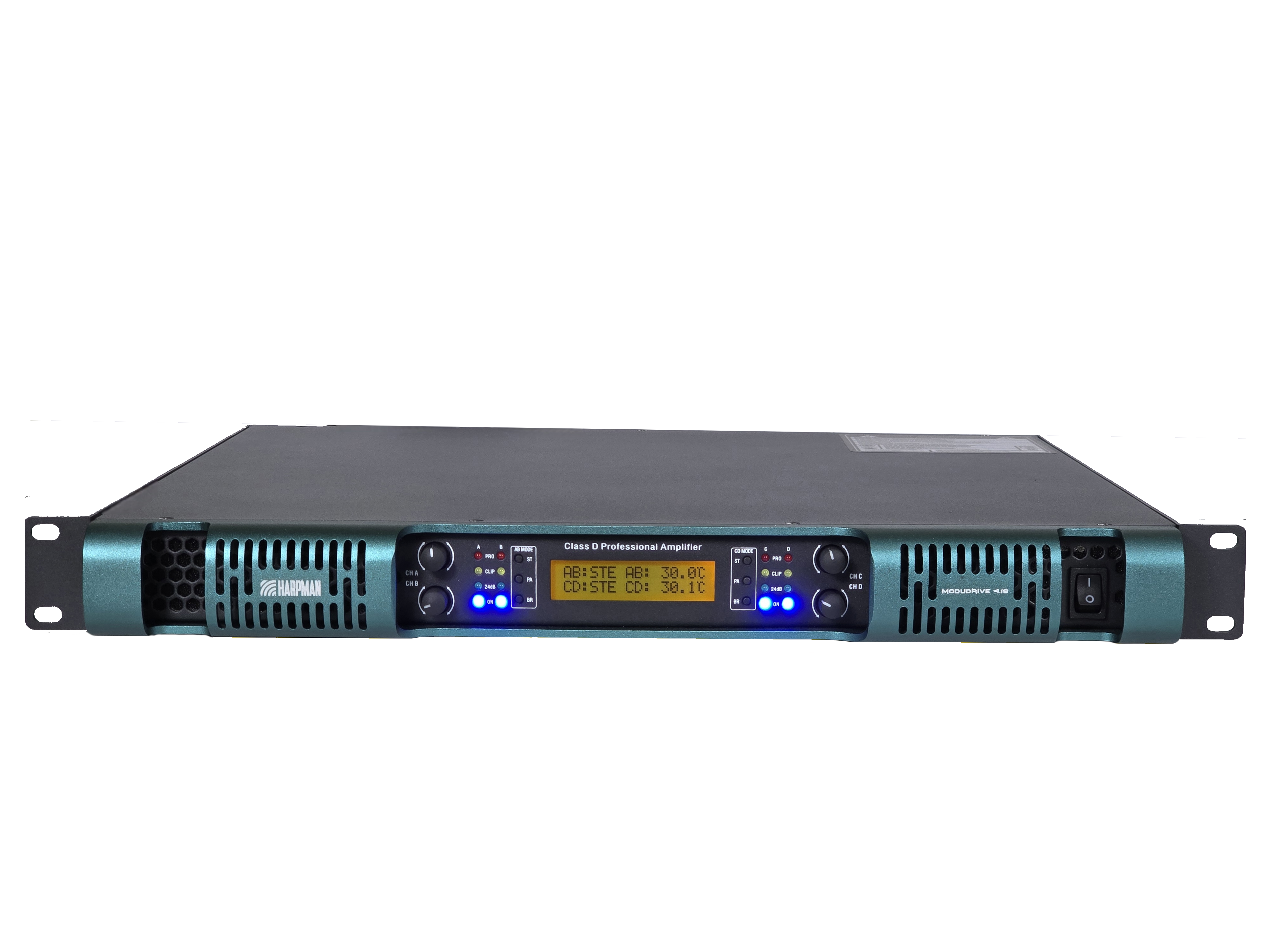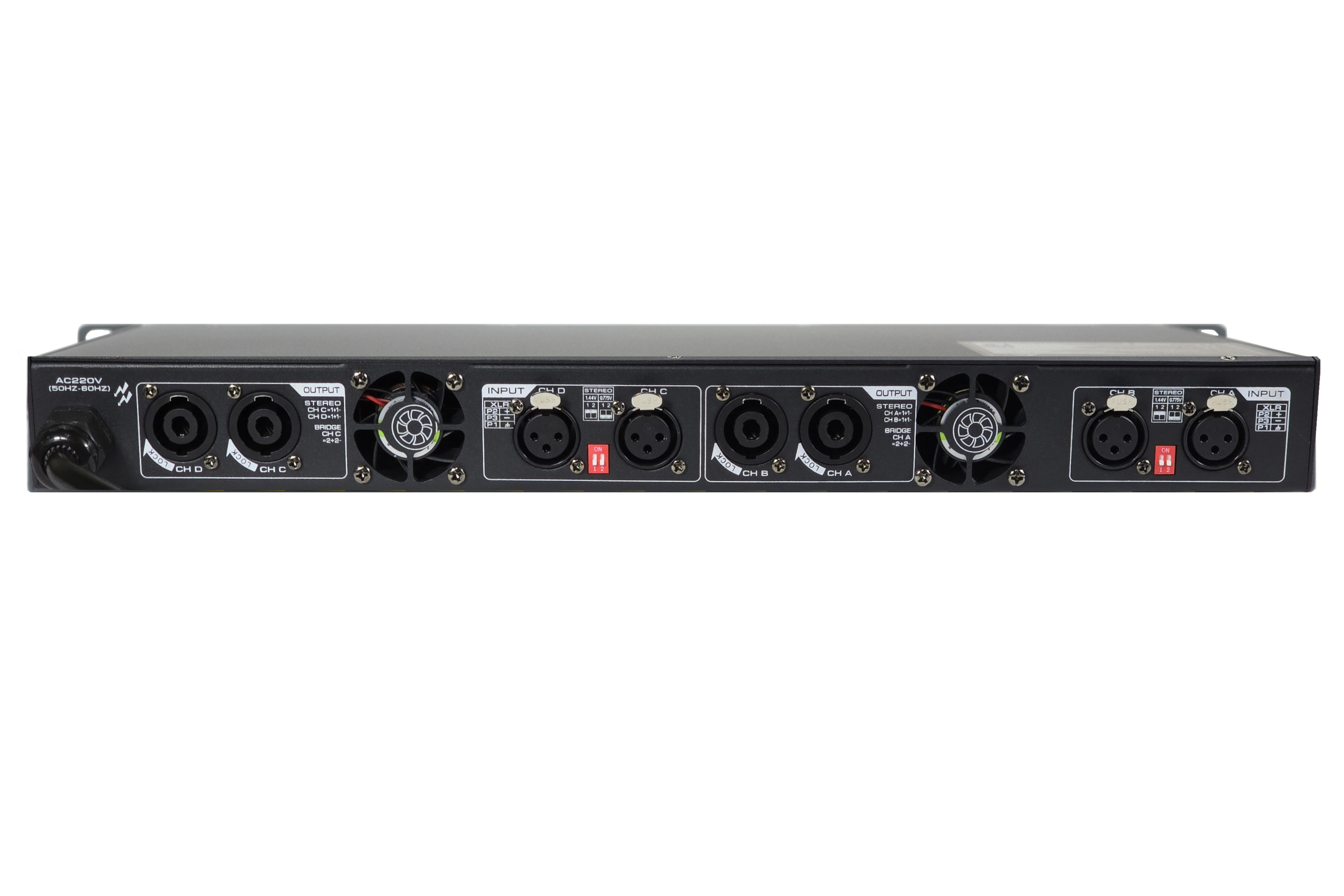

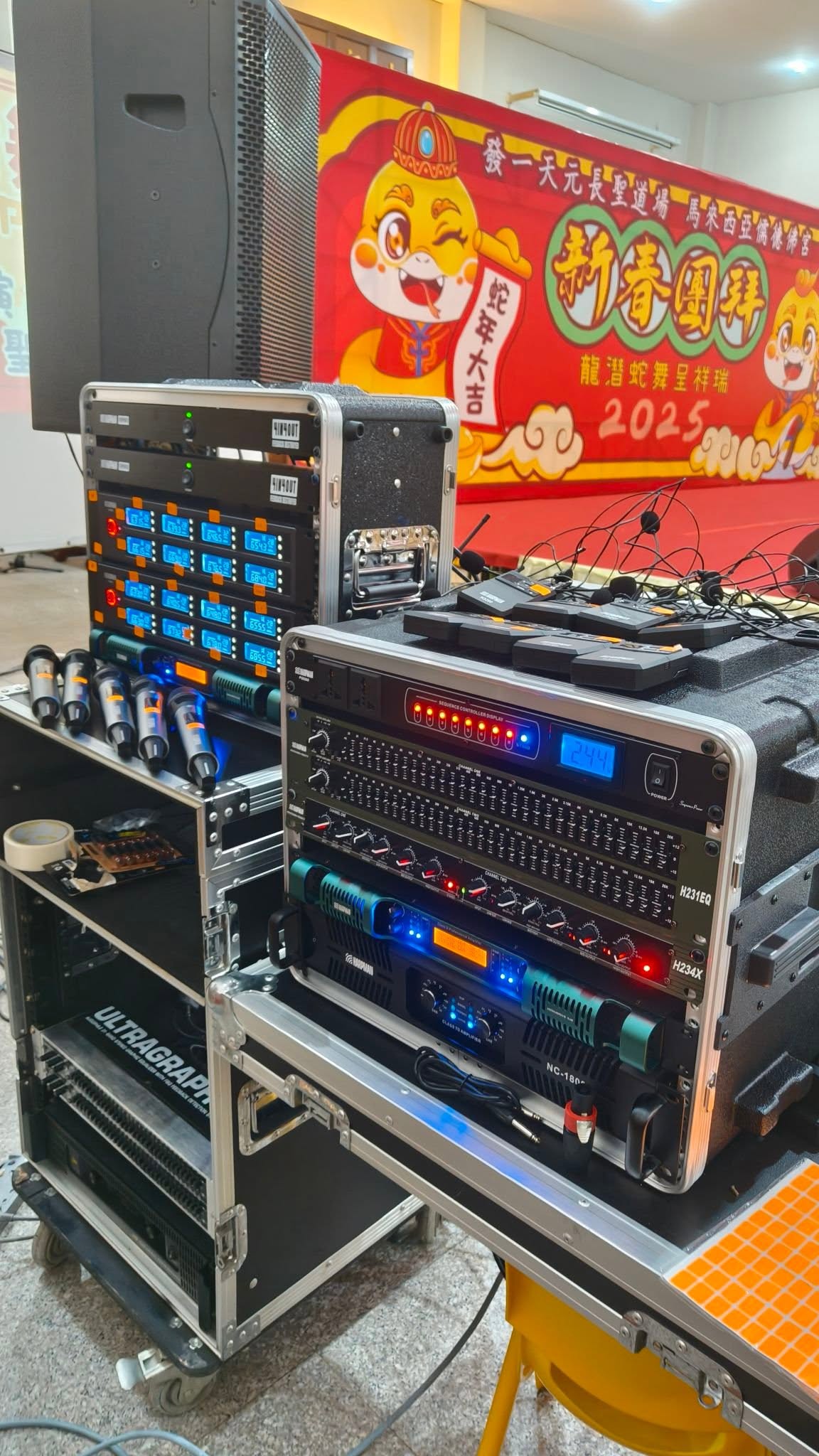
A power amplifier does one important job: it takes the small signal from your mixer or processor and boosts it enough to drive your speakers. Choose the wrong power amplifier and you may get weak, distorted sound, or even damaged speakers.
This guide explains the key numbers you will see on a power amplifier and on speakers, and how to match them properly.
Watts: how much power?
Power is measured in watts (W). You will usually see several ratings:
- RMS (continuous) power: The power that can be delivered or handled continuously. This is the number to use when matching a power amplifier and speakers.
- Program power: A higher figure that reflects music with changing levels.
- Peak power: The highest short burst the equipment can handle. It is the biggest number, but the least useful for matching.
When comparing products, always compare RMS to RMS. A peak rating on one product and an RMS rating on another is not a fair comparison.
Ohms: impedance
Speakers have an impedance, measured in ohms (Ω). Common values are 8Ω and 4Ω. A power amplifier lists its output at specific impedances, for example “300W at 8Ω, 500W at 4Ω per channel”.
- A lower impedance draws more current from the amplifier. Most power amplifiers deliver more power into a lower impedance, up to a limit.
- Every power amplifier has a minimum load (for example 4Ω). Connecting speakers below this can cause it to overheat, shut down or be damaged. Always check the specification.
Connecting more than one speaker
When several speakers share one power amplifier channel, the way you connect them changes the total impedance.
Parallel connection (most common in PA systems): the total impedance drops.
| Speakers on one channel | Each speaker | Total load |
|---|---|---|
| 1 speaker | 8Ω | 8Ω |
| 2 speakers in parallel | 8Ω | 4Ω |
| 4 speakers in parallel | 8Ω | 2Ω |
| 2 speakers in parallel | 4Ω | 2Ω |
Series connection: impedances add up, so two 8Ω speakers in series give 16Ω. This is less common in professional PA.
Always calculate the total load and make sure it does not go below the amplifier’s minimum rating. If you have many speakers, ask a supplier how to wire them safely. Large installations often use a different approach, such as constant-voltage (70V/100V) lines.
How much power amplifier do you need?
A common guideline is to choose a power amplifier that delivers about 1.5 to 2 times the speaker’s RMS rating, at the speaker’s impedance. This gives headroom, so peaks in the music or voice do not push the amplifier into distortion.
Example 1: one speaker per channel
- Speaker: 8Ω, 300W RMS
- Suggested amplifier: about 450–600W per channel at 8Ω
Example 2: two speakers per channel, wired in parallel
- Speakers: two speakers, each 8Ω and 300W RMS
- Total load: 4Ω, and 600W RMS total
- Suggested amplifier: about 900–1,200W per channel at 4Ω, and stable at a 4Ω load
These are guidelines only. Always check the speaker and amplifier manuals, or ask your supplier.
Can a big amplifier damage my speakers?
It is a common worry, but the more common cause of damage is actually the opposite: an underpowered amplifier being pushed too hard. When a power amplifier runs out of power and clips, it produces distorted signals that can overheat and burn speaker components, especially the tweeters.
A properly sized power amplifier, with the gain set correctly, can be safer for your speakers than a small amplifier turned up to its limit. Even so, use sensible gain settings, and consider a limiter in your processor to protect your speakers.
Speaker sensitivity: why it matters
Speaker sensitivity tells you how loud a speaker is for a given input power, usually measured in dB at 1 watt, 1 metre.
- +3 dB more sensitivity means the speaker needs half the power for the same volume.
- Around +10 dB is heard as roughly twice as loud, and needs about 10 times the power.
So a more efficient speaker can achieve the same volume with a smaller power amplifier, and a difference of a few dB in sensitivity can change the amplifier you need.
Class AB and Class D power amplifiers
- Class AB: The traditional design. Usually heavier and produces more heat.
- Class D: Modern, efficient, lighter and runs cooler. Widely used in today’s professional power amplifiers.
Both can perform well. Instead of focusing only on the class, look at the specifications, protection features, build quality and the support that comes with the product.
Features to look for in a power amplifier
- Protection circuits: thermal, short-circuit and DC protection
- Suitable connectors: XLR or TRS inputs, and locking outputs such as Speakon where needed
- Front-panel gain controls and clear level indicators
- Bridge mode for more power into one speaker; check the higher minimum impedance requirement in the manual
- Reliable cooling with fans or heat sinks, and enough ventilation space
Installation tips for Malaysia’s climate
- Give amplifiers room to breathe. Do not stack them tightly without airflow. Leave space or use vent panels in the rack.
- Keep racks cool. Avoid direct sunlight and enclosed hot spaces. A ventilated or air-conditioned room helps the equipment last.
- Use proper power. Use grounded sockets and avoid overloaded extension cords.
- Protect against dust and moisture. Keep the rack clean and dry.
Checklist before you buy a power amplifier
- Speaker RMS power and impedance
- How many speakers per channel, and how they are connected
- The total load in ohms, and that it is above the amplifier’s minimum
- Amplifier power at that impedance, about 1.5–2× the speaker RMS total
- Space for ventilation in your rack
- Required connectors and protection features
- Warranty and after-sales support
Frequently asked questions
Can I connect a 4Ω speaker to an 8Ω power amplifier?
It depends on the amplifier. Look at the amplifier’s minimum load. If it is rated for 4Ω, it is fine. If it is not, do not connect it.
Can I use a higher-power amplifier than the speaker’s rating?
Yes, within reason, and it is common to have some headroom. Be careful with the gain and volume, and use a limiter where possible.
What does bridged mono mean?
It combines two channels of a stereo power amplifier into one, giving more power to a single speaker or load. Check the manual for the required minimum impedance in bridge mode.
Do active speakers need a separate power amplifier?
No. Active speakers already have amplifiers built in. This guide applies when you use passive speakers.
Need help choosing a power amplifier?
Send us your speaker model, the number of speakers and how you plan to use them. The Harpman Malaysia team will recommend a matching power amplifier and give you a free quote.
Related reading: